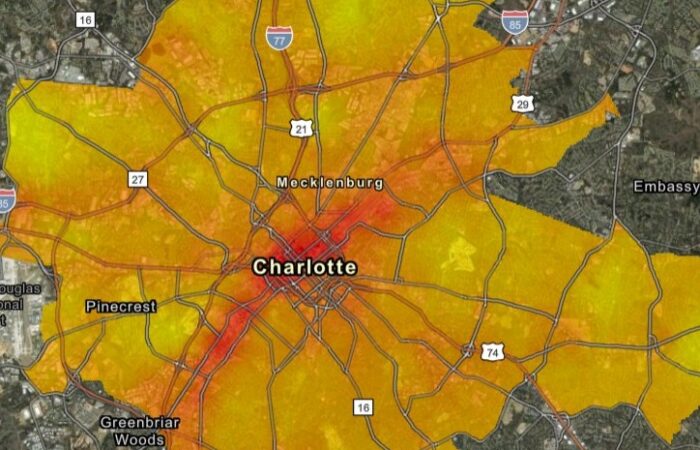
Charlotte, N.C. — We applaud Secretary Regan and the U.S. Environmental Protection Agency for strengthening our nation’s soot standards. Yet while the new standard of 9 µg/m³ will save an estimated 4,500 lives each year, it is not strong enough to adequately protect public health. CleanAIRE NC advocates for strengthening the National Ambient Air Quality Standards (NAAQS) on dangerous soot pollution to a minimum of 8 µg/m³.
Andrew Whelan
Communications Manager
(919) 408-7031
[email protected]
Soot particles are easily inhaled into our lungs, where they are small enough to pass into our bloodstream and wreak havoc on other primary organs, including the heart and brain. In North Carolina, nine of ten leading causes of death can be caused or worsened by particulate matter.
According to the American Lung Association, 63 million Americans experience the short-term effects of particulate matter daily. That’s 17% of the national population. And these health burdens are not shared equally. Black, Indigenous, and people of color (BIPOC), in addition to low-income communities, routinely face the highest levels of soot pollution. Children, seniors, pregnant women, people with underlying medical conditions (e.g. asthma, COPD, heart disease), low-income communities, and outdoor workers are also disproportionately impacted by daily PM2.5 exposure.
To be clear, there is no evidence for a safe level of PM2.5 exposure that can avoid adverse health effects. And while the World Health Organization recommends a comparatively rigorous limit of 5 µg/m³, the EPA’s new standard falls short of even the 8 µg/m³ limit recommended by their own Clean Air Scientific Advisory Committee. Simply put, reducing soot pollution will save even more lives.
Today’s announcement represents the first time the EPA has strengthened the NAAQS on soot since 2012. This is a significant and much-needed step in the right direction, but still falls short of reflecting our public health reality. Meanwhile, the EPA’s decision to not update daily standards from 35 µg/m³ will allow avoidable exposure risks to our most vulnerable populations to continue. CleanAIRE NC urges the EPA to strengthen our soot standards to a minimum of 8.0 µg/m³, while setting the secondary 24-hour PM2.5 standard to 25 µg/m³. We also encourage the Air Quality Index (AQI) to improve public communications about the risks of soot exposure.
###
CleanAIRE NC is a statewide nonprofit organization advocating for the health of all North Carolinians by pursuing equitable and collaborative solutions that address climate change and air pollution. www.CleanAIREnc.org