FOR IMMEDIATE RELEASE
July 28, 2026
MEDIA CONTACT
Andrew Whelan, CleanAIRE NC, (919) 229-9293, [email protected]
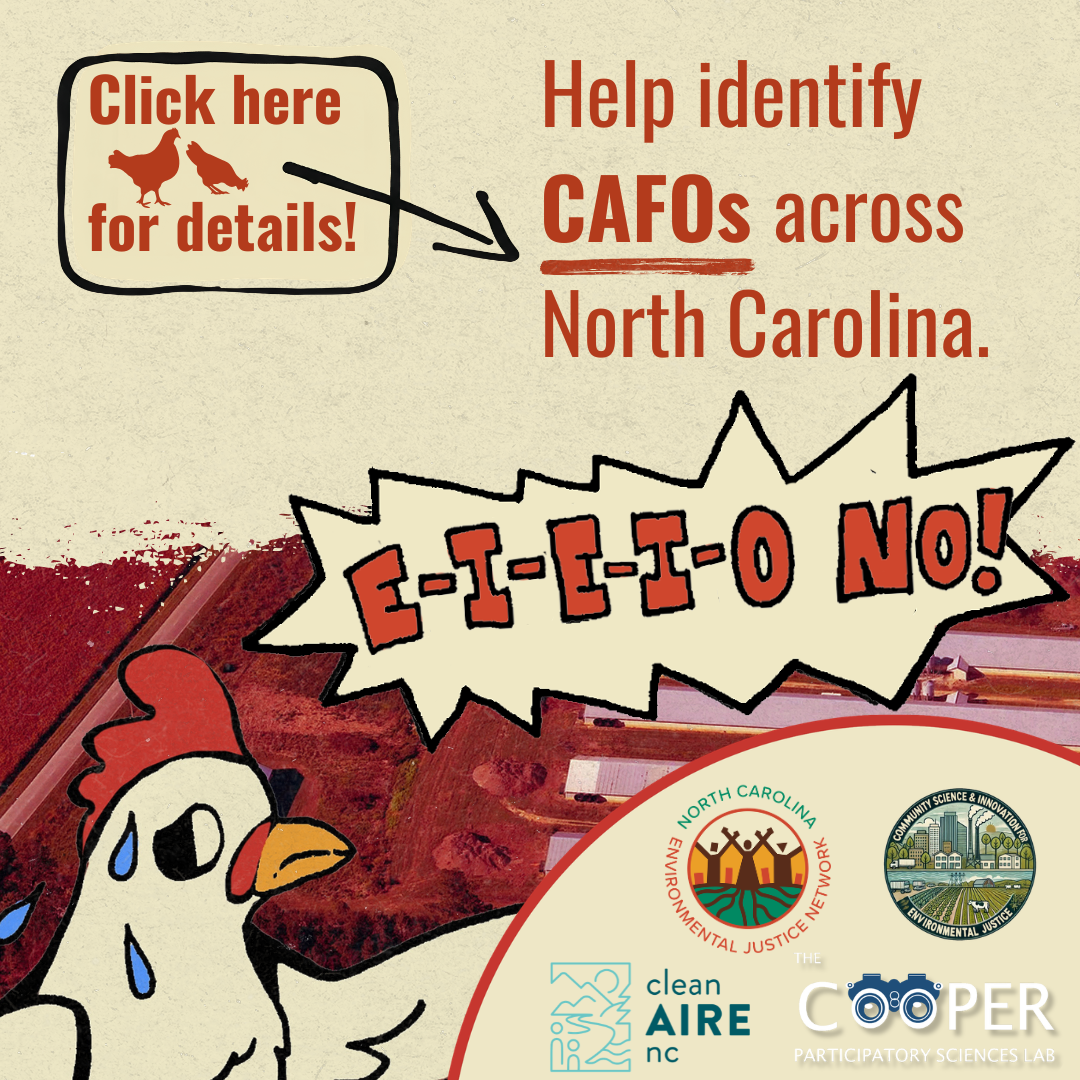
Raleigh, N.C. — The North Carolina Environmental Justice Network and CleanAIRE NC, in collaboration with the Cooper Participatory Sciences Lab at NC State University and the Community Science and Innovation for Environmental Justice Lab at Johns Hopkins University, announce the official launch of E-I-E-I-O No, an innovative community science initiative designed to map the hidden footprint of industrial agriculture across North Carolina. The project leverages open-source aerial imagery and grassroots collective action to provide greater transparency on Concentrated Animal Feeding Operations (CAFOs), also called Factory Farms, and their impact on human health, and air and water quality.
CAFOs are industrial-scale, high-density livestock facilities that confine thousands of swine or poultry into small indoor spaces. Each CAFO generates over hundreds of thousands tons of animal waste annually, contaminating local air and water with urine, feces, and harmful pollutants such as ammonia, hydrogen sulfide, and particulate matter.
North Carolina is a major hotspot for the CAFO industry, with thousands operating across the state. Yet a lack of public data, particularly on poultry, has left communities in the dark, with limited tools to verify where these facilities operate or track their growth. E-I-E-I-O No addresses this problem by inviting anyone to participate as community scientists scanning images from eastern North Carolina to document facility locations and identify the types of animals being reared. The project aims to produce a transparent, crowdsourced map of CAFOs and their proximity to local communities.
“E-I-E-I-O No takes a community-inclusive approach not always considered in data collecting and research projects,” said Z Strawderman, AirKeeper Dashboard & GIS Manager for CleanAIRE NC. “It will produce a dataset that is verified and shared back to the communities who are directly impacted by the practices of the industry.”
“In North Carolina, the public legally has the right to know where polluting industries are located,” said Dr. Chris Lamont Brown, NCEJN’s Co-Director for Research and Education. “However, in the case of poultry CAFOs specifically, this right has been stripped away. E-I-E-I-O No leverages scientific practices to fight for our right to information that keeps us safe.”
CAFOs are disproportionately located near low-income communities and communities of color, constituting a severe environmental justice issue. The airborne emissions and water runoff from these high-density operations could be linked to elevated rates of asthma, respiratory illness, and decreased quality of life for neighboring residents.
E-I-E-I-O No is designed to be user friendly, so that anyone can participate. Volunteers do not need a background in environmental science or geographic mapping. The platform guides users through simple visual cues to identify the distinct infrastructure of industrial facilities such as waste lagoons.
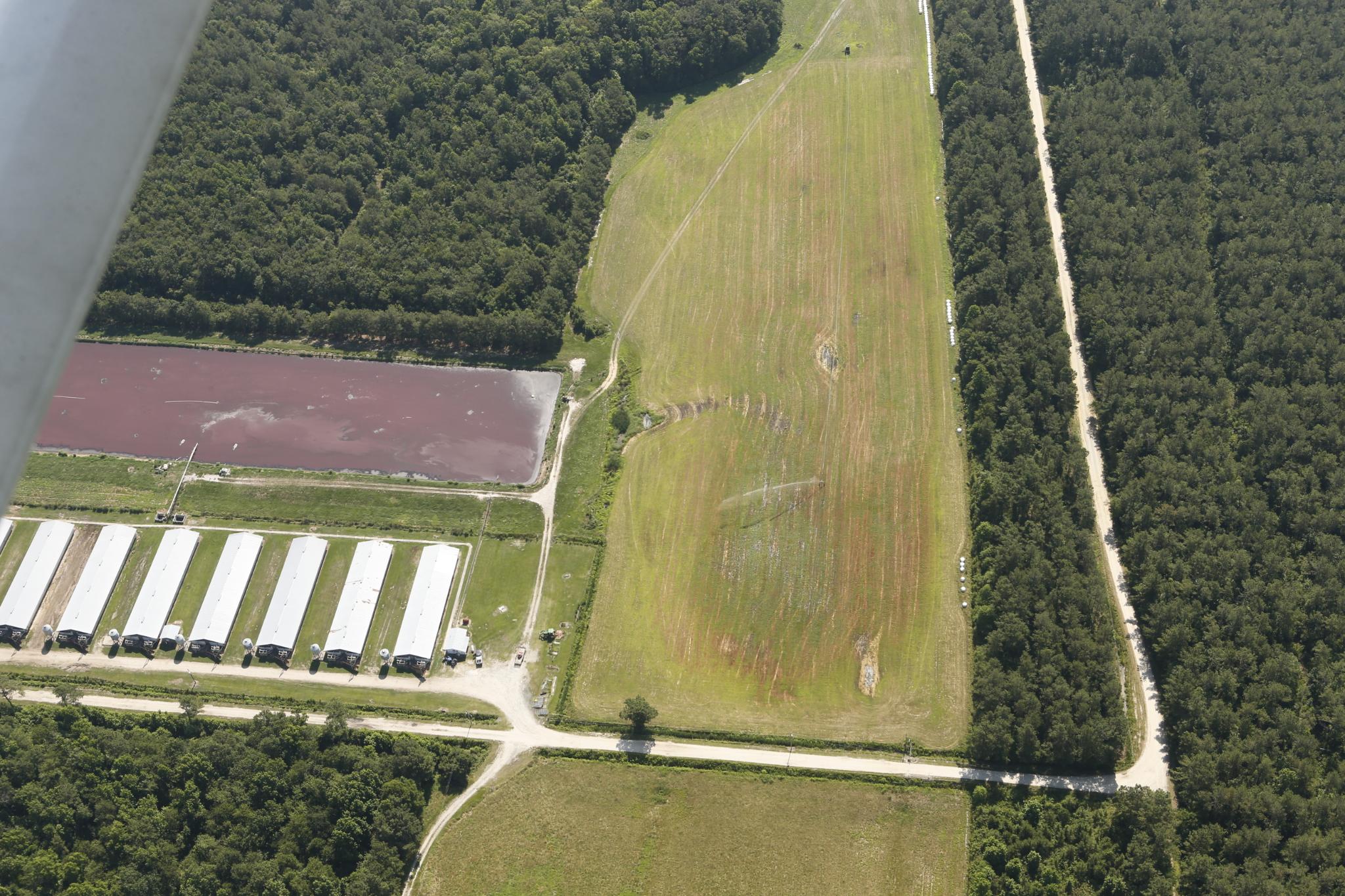
By dividing the massive task of analyzing aerial imagery across eastern North Carolina into bite-sized, manageable chunks, the project demonstrates how collective civic action and community science can rapidly scale up data transparency and public oversight. The data gathered by the public will be made available through CleanAIRE NC’s AirKeeper Dashboard. This will enable communities, researchers, and policymakers to assess cumulative public health impacts, guide sustainable zoning decisions, and advocate for stronger air and water protections.
Aerial ortho imagery for this project was accessed from NC One Map, which hosts open-source imagery of all of North Carolina’s counties. E-I-E-I-O No is hosted by Zooniverse, the world’s largest platform for people-powered research.
To learn more about the initiative or to sign up as a volunteer community scientist, visit www.zooniverse.org/projects/blerdapprentice/e-i-e-i-o-no.
###
Founded in 1988, the North Carolina Environmental Justice Network (NCEJN) is a grassroots, people of color-led coalition that builds power with systemically marginalized communities to resist climate, environmental, racial, and social injustice. https://ncejn.org
CleanAIRE NC is a statewide nonprofit organization advocating for the health of all North Carolinians by pursuing equitable and collaborative solutions that address climate change and air pollution. www.cleanAIREnc.org
The Cooper Participatory Sciences Lab at North Carolina State University supports broad public engagement in citizen and community science projects. https://faculty.cnr.ncsu.edu/carencooper/
The CSI-EJ Initiative in the Johns Hopkins Center for a Livable Future uses science to advance cutting-edge, community-driven research designed with, by, and for communities living at the fence line of CAFOs. The Initiative aims to respond to these communities’ concerns and lived experiences and support movements for environmental justice with an integrated scientific, policy, and civic engagement backbone. https://clf.jhsph.edu/